Here4 High-Precision Dual-Band RTK Navigation
Features
- High-Precision GNSS Module: Equipped with the u-blox F9P, a professional high-precision dual-band RTK navigation module.
- Powerful Processing: Features a built-in STM32H7 chip for real-time processing and data optimization, running the industry-standard AP_Periph firmware for unmanned systems.
- Advanced Dual-Band Antenna: The tailor-made dual-band antenna from Taoglas supports L1 and L5 frequencies, delivering high gain, sensitivity, and stability.
- Drone-ID Capability: Integrated Drone-ID functionality. (Blue version supports Drone-ID.)
- Reliable RTK Positioning: Utilizes multi-frequency DGNSS signals with advanced algorithms for fast convergence to an RTK fix, ensuring stable and reliable centimeter-level positioning.
- Compact and Lightweight: The Here 4 module measures 16 x 68 mm and weighs 60 g.
- Embedded ProfiLEDs: Includes LEDs with multiple display modes for notifications or navigation signals. These modes can be customized for specific scenarios using parameters or onboard Lua scripting.
- CAN FD Compatibility: Provides real-time data transmission with a high transmission rate via CAN FD.
- Built-in IMU: Features an integrated IMU. Future firmware updates will enable tightly coupled DGNSS-INS fusion solutions for enhanced accuracy.
User Manual
1. For Use with ArduPilot
To begin, connect the 4-pin CAN cable from the Here 4 module to the CAN1 or CAN2 port on the flight controller. Note that the current firmware supports only CAN1, which corresponds to the green, blue, white, and grey wires.
Next, power on the flight controller and establish a connection with Mission Planner. Navigate to the Config > Full Parameter List page and update the following Parameters:
- Set CAN_D1_PROTOCOL to 1.
- Set CAN_D2_PROTOCOL to 1.
- Set CAN_P1_DRIVER to 1.
- Set CAN_P2_DRIVER to 1.
- Set GPS_TYPE to 9.
- Set NTF_LED_TYPES to 231.
The Here 4 module does not include a built-in safety switch. To disable the safety switch, you can adjust the BRD_SAFETYENABLE parameter to 0. Alternatively, an external safety switch can be connected to the GPS1 port if desired.
When using the Cube Orange+ flight controller, the compasses are prioritized in order from bottom to top. By default, the external CAN compass is selected as the primary compass.


2. Using with PX4
At the time of writing, PX4 v1.13 is being used. Please ensure that you are using the most recent stable release of the PX4 firmware.
To begin, install the PX4 firmware and connect the 4-pin CAN cable to either the CAN1 or CAN2 port on the autopilot.
Next, establish a connection to the autopilot via the Ground Control Station (GCS). Once connected, modify the UAVCAN_ENABLE parameter to Sensors Automatic Config and then reboot the autopilot to apply the changes.

3. Firmware update
The update procedures will be provided in the event of any future firmware updates.
Mission Planner must be updated to the specified version or a later one in order to access the new Features.

Connect the 4-pin CAN cable from the CAN port on the Here 4 module to the CAN1 port on the autopilot.
Next, connect the autopilot to Mission Planner and navigate to the UAVCAN screen. From there, click on SLCan Mode CAN1 to load the CAN GPS Status.


4. Cube_ID setting
5. RTK Use Operation
1. Base/Rover Survey by Mission Planner
This section of the tutorial provides operating instructions using Mission Planner ground software and Arducopter-4.3.5 flight firmware. RTK mode requires a base station, and the following tutorial uses "Here+" base stations as an example. Users may also use other u-blox M8P/F9P base stations (such as HerePro, etc.) or local wireless RTK correction Services.
Preparation Before Use:
To use the Here 4 on a UXV, the following hardware is required: a computer, telemetry modules, Here 4, Here+ base antenna, Here+ base, and a tripod (stand).

Before use, ensure that the hardware connections are correct.
On the ground side, connect the base antenna to the base station, and then connect the base station module to the computer using the USB port. The telemetry module should be connected to another USB port on the same computer.
On the UXV side, connect the Here 4 to the CAN interface, and connect the telemetry module to the TELEM interface on the flight Controller.

Antenna Placement
For normal GPS positioning, placing the device near a window is typically sufficient to receive a GPS location over time. However, this is not adequate for RTK. RTK requires more stringent antenna placement conditions compared to GPS.
The ideal environment for both the base and rover antennas is one with a clear view of the sky, at least 30 degrees above the horizon. The RTK antenna can be elevated, but it is important to ensure that there are no obstacles around, such as buildings, trees, or vehicles, that could interfere with the Signal.
Examples of poor environments include indoors, urban areas, forests, or locations close to the ground.
Examples of ideal environments include open spaces, mountaintops, or the roof of a Building.
Do not place the antenna near electronic devices, as high-power electronics in close proximity may interfere with the GPS signal by generating radio frequency noise. Examples of such devices include mobile phone base stations, high-voltage transformers, and similar equipment.
Ensure that the base station is placed in an outdoor environment with adequate sky coverage to receive a strong satellite signal.
For optimal performance, position the base station on a stable and elevated platform, such as a tripod.

Begin by setting up the base module. During this process, the rover and the UXV do not need to be powered on.
Open the Mission Planner ground station software on your computer and navigate to Initial Setup > Optional Hardware > RTK/GPS Inject. You will then see the following page:
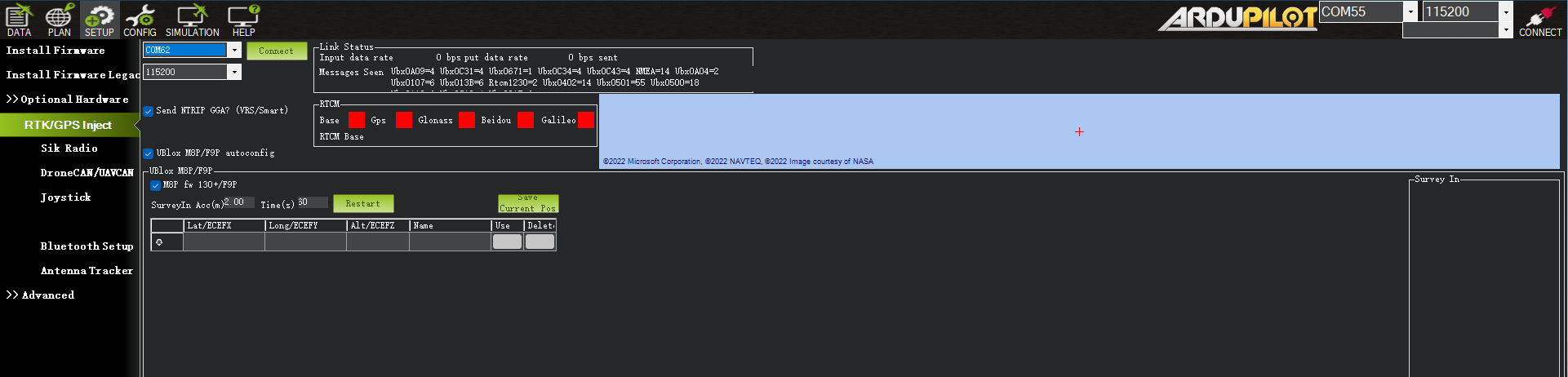

- The Position is invalid: This indicates that the base station has not yet reached a valid location.
- In Progress: The survey is still ongoing.
- Duration: The number of seconds that the current surveying task has been running.
- Observation: The number of observations that have been acquired.
- Current Acc: The absolute geographic accuracy that the base station is currently capable of achieving.
The base station requires a certain amount of time to meet the accuracy requirements specified. Testing has shown that in an open area with clear sky coverage, the base station can achieve an absolute accuracy of 2 meters within a few minutes. To reach an absolute accuracy of less than 30 cm, it takes about an hour, and to achieve an accuracy of 10 cm, it may take several hours.
It is important to note that the absolute geographic accuracy of the base station will affect the absolute accuracy of the rover module, but it will not impact the relative accuracy between the base station and the rover. If your application does not require the UXV to have high absolute geographic accuracy, you do not need to set the base station's precision too high, as this will help reduce the survey time.
Even if the base station's accuracy is between 1.5 and 2 meters, the rover module's positioning accuracy relative to the base station can still reach centimeter-level precision.
Once the survey is complete, Mission Planner will display the following page:

In the RTCM box, you will see that the base status indicator is green, and both the GPS and GLONASS satellite systems are also green (if you wish to change the satellite system, refer to the following section). The box on the right will display "Position is valid."
To store the current location in Mission Planner, click Save Current Pos, enter a name in the dialogue box, and click OK. As shown below, your saved location will appear in the list. Click the Use button next to the saved location. The base station will then enter fixed mode, and the status will show Using FixedLLA. In the future, when setting the base station at the same location, you will not need to repeat the survey. Simply click the Use button next to the location you saved..


2. Single Base to Multiple Rovers
There are two methods to accomplish this:
-
Use a single telemetry module for multiple telemetry broadcasting.
-
Use multiple 1-to-1 telemetry modules with a USB hub.
For the ground station configuration, connect all telemetry modules to the computer via a USB hub. Open Mission Planner to locate the base station, then connect it to the flight controller. Select "AUTO" for automatic connection, as shown below. All recognized flight controllers on the available ports will be connected. You can then select the UXV from the dropdown list.

6. U-Center Firmware Update
Make sure that you have the latest firmware installed on the Here4 before proceeding with this process. To update the firmware, please refer to section 3, "Firmware Update."
The latest NEO F9P L1L5 firmware can be found in the Firmware Update section here: NEO F9P Firmware Update.
- 1. Inside the DroneCAN/UAVCAN configuration page in Mission Planner, select the menu and check the options.
If the option is not visible in Mission Planner, update Mission Planner to the latest beta version from the Help menu.

- 2. Select the port for u-Center to connect to.

- 3. Select the baud rate to use for u-blox communication.

- 4. Open u-center (ensure you are using version 22.07 or later). Under the "Connections" menu, select "Network Connections" and then click "New."

- 5. Set the URL to tcp://127.0.0.1:500.

- 6. Select "Tools" > "Firmware Update Utility." In the tool, choose the firmware you downloaded from the u-blox website. Ensure that the baud rate matches the one set in Mission Planner, and verify that the options are correctly selected as shown below. Then, click "GO."

Centimeter level of high-precision positioning
Equipped with the u-blox NEO-F9P L1/L5 RTK Multi Constellation GNSS module, fastest lock times of any of the Standard Here GPS series. Reliable centimeter-level navigation.
More OnBoard compute, and Mems
Built-in a dualcore 480MHz / 240MHz ARM7 / ARM4 MPZU. The combination of our most accurate magnetometer yet and precision 6 degree of movement inertial measurement unit has better performance in more applications.
- Dual-core processor
- Barometer
- IMU: Magnetic Compass, Gyroscope & Accelerometer
Integrated module with multiple features
Here4 is more than a GNSS module. It integrated both flight control and navigation capabilities. Fitted with 8 PWM or BDSHOT outputs, an RCIN, Hotshoe and camera trigger, accurate mapping has never been more self contained.
Supports further Expansion / customization
The reliable DRONECAN FD communication protocol ensures fast (8Mbps) and stable transmission. Based on the AP-Periph open source platform, users can better carry out further development and customization. It also supports serial, and I2C for additional sensor integration.
| Item information | Value |
|---|---|
| Manufacturer: |  |
| SKU: | 211519 |
Manufacturer information:
Specifications
| Features | Description |
| GNSS Module | NEO-F9P |
| Processor | STM32H757 |
| IMU Sensor | ICM42688 + RM3100 |
| Barometer | MS5611 |
| Communication Protocol | DroneCAN 8Mbit/s |
| Receiver Type | Dual-band GNSS high precision receiver |
| GNSS Systems | GPS, GLONASS, Galileo, and BeiDou + SBAS and QZSS |
| Satellite Bands | B1l, B2a, E1B/C, E5a, L1C/A, L1OF, L5 |
| Maximum GNSS Systems | 4 |
| Navigation Update Rate (RTK) | Up to 20 Hz |
| Positioning Accuracy | 0.01 m + 1 ppm CEP |
| Maximum Speed | 500 m/s |
| Convergence Time (RTK) | < 10 seconds |
| Acquisition | Cold Start: 25 s Aided Start: 2 s Hot Start: 2 s |
| Sensitivity | Tracking & Navigation: -167 dBm Cold Start: -148 dBm Hot Start: -157 dBm Reacquisition: -160 dBm |
| Antenna | Dual-band antenna |
| Protocols | NMEA, UBX binary, RTCM 3.3, SPARTN 2.0.1 |
| Anti-Spoofing | Advanced anti-spoofing algorithms |
PINOUT

| CAN | x2 (Current Firmware supportsonly CAN1: green, blue, white, gray) |
| Operating Temperature | -40°C to +85°C |
| Size | 16 x 68 mm |
| Weight | 60 g (with cable) |